
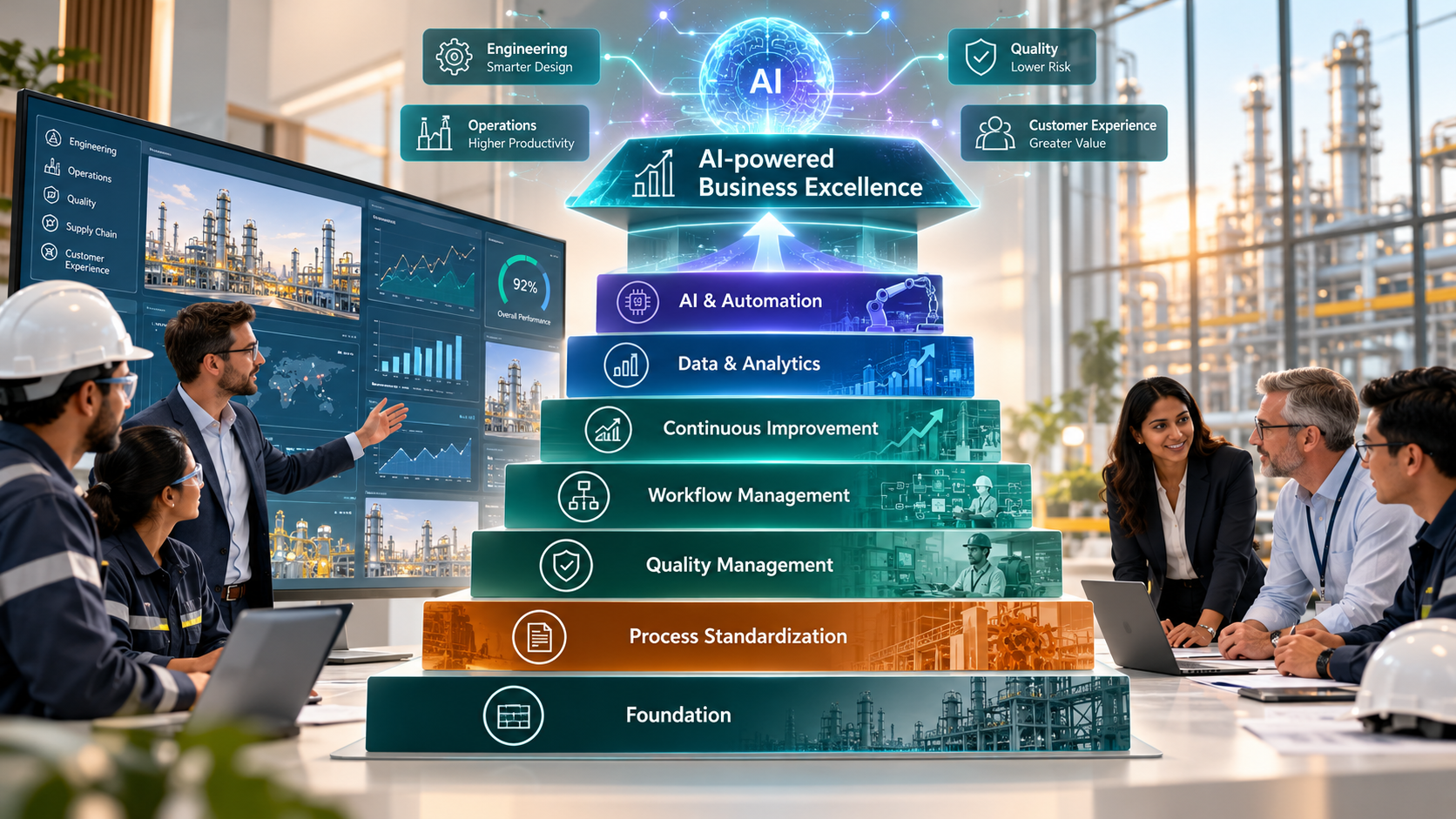
AI does not create Business Excellence simply because an organization deploys it. AI creates value when it is applied to a process that is understood, measured, supported by reliable data and connected to a clear business decision or customer outcome. SMART CI™ Level 5 focuses on using AI and automation to strengthen mature processes, not to hide process weaknesses.
In this article, you will learn
- Why AI adoption and AI value are not the same thing
- What process maturity has to do with successful AI
- The five questions leaders should answer before implementing AI
- Where AI can strengthen Engineering, Quality, Business Excellence and Customer Experience
- Why the ultimate goal is customer value, not technology adoption
Everyone Is Asking, “Where Can We Use AI?”
AI has changed the leadership conversation.
CEOs want AI strategies. Functions are testing copilots. Teams are experimenting with automation. Dashboards are becoming smarter. Every department seems to have an AI use case.
But there is a better question:
“Where do we have a business problem that AI can solve better than the current way of working?”
That small change in language matters. The first question starts with technology. The second starts with business value.
Research from McKinsey & Company supports this distinction: organizations seeking meaningful value from generative AI are redesigning workflows and strengthening governance rather than simply adding tools to existing work.
That is exactly why AI appears at Level 5, not Level 1, in the RAAS SMART CI™ journey.
The AI Maturity Trap
Imagine an organization with inconsistent SOPs, unreliable data, unclear ownership, recurring quality problems, fragmented systems, manual workarounds and poor process visibility.
Now add AI.
Faster at processing inconsistent information?
Faster at routing poorly defined work?
Faster at producing reports from unreliable data?
Faster at scaling a process nobody fully understands?
Technology cannot indefinitely compensate for process weakness. The smarter approach is to improve the system AI will operate inside.
The SMART CI™ Sequence
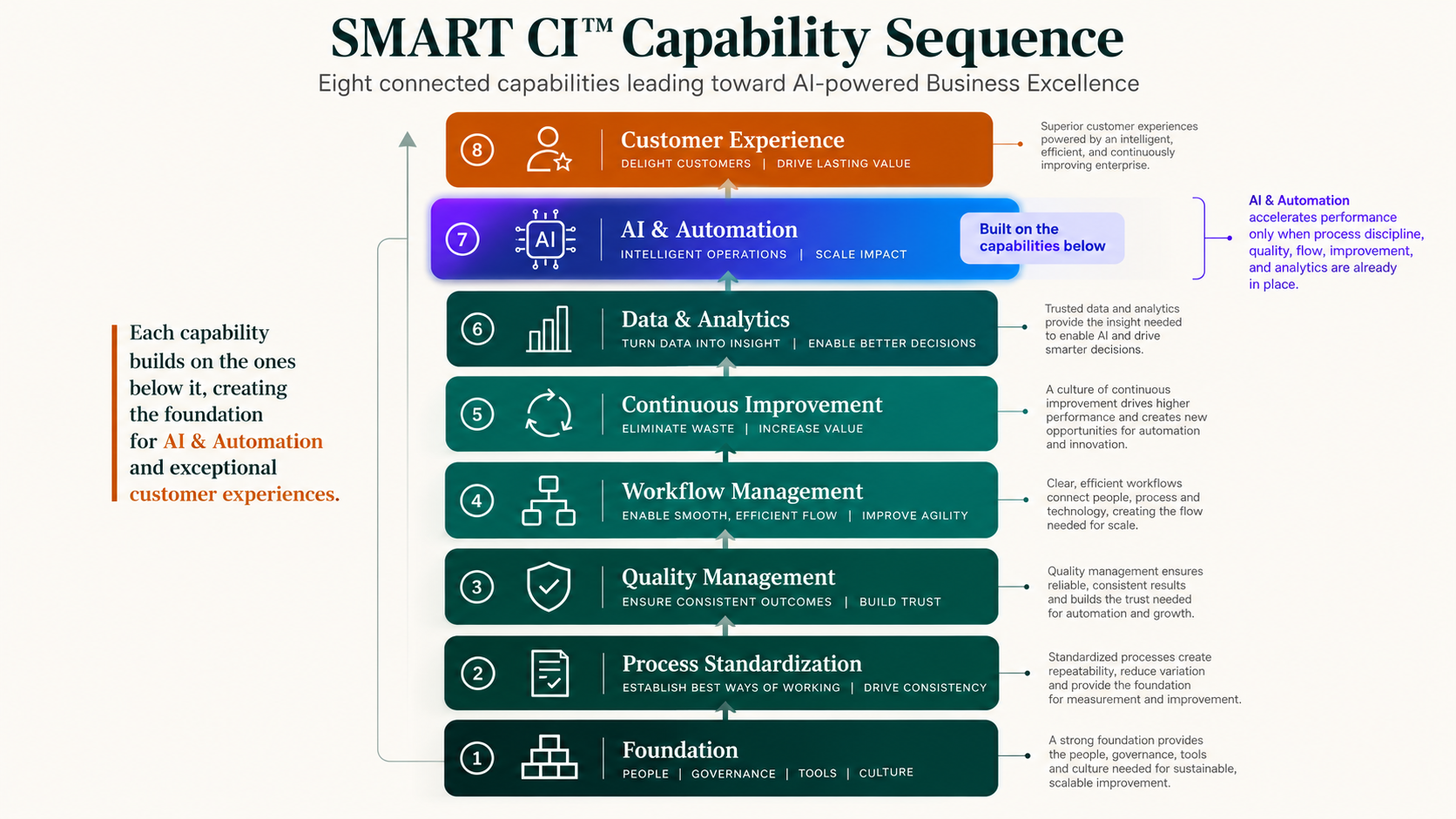
SMART CI™ looks at transformation through eight connected capability dimensions. These are not eight isolated initiatives. They build on each other.
Foundation provides direction. Standardization creates repeatability. Quality reduces failure. Workflow Management improves flow. Continuous Improvement creates learning. Data & Analytics makes performance visible. AI & Automation increases intelligence and speed. Customer Experience answers the final question: did any of this create greater value for the customer?
Level 5: AI-Powered Business Excellence
At SMART CI™ Level 5, the leadership conversation changes. The objective is no longer “We need an AI initiative.” It becomes:
“Where can AI improve an important business process or decision?”
Before approving an AI use case, leadership should be able to answer five questions.
1. Do We Understand the Process?
What exactly happens today? Where does the process start? Who owns each step? Where are the handoffs? Where does work wait? Which rules drive decisions?
If the current process cannot be explained clearly, it is difficult to know what AI should improve. A Value Stream Mapping or process-mapping exercise can make this current state visible before technology choices are made.
2. Do We Understand the Problem?
A good AI initiative begins with a specific performance gap. Where are we losing time, quality, capacity, cost or customer value?
Not: “We need AI in Quality.”
Better: “Customer complaint analysis currently takes several days and repeated patterns are difficult to identify across thousands of records.”
Now AI has a purpose.
3. Can We Trust the Data?
AI depends heavily on the information available to it. If defect coding is inconsistent, historical records are incomplete or process data is unreliable, the resulting AI insight may also be unreliable.
That is why Data & Analytics comes before AI & Automation in SMART CI™. NIST's AI Risk Management Framework similarly emphasizes governing, mapping, measuring and managing AI risks throughout the lifecycle.
4. What Decision Should Become Better?
AI should help someone make a better decision, faster.
Quality
Which defect requires attention first?
Projects
Which project is at risk?
Customer
Which account needs intervention?
Operations
Which machine behavior is abnormal?
If the improved decision is unclear, the value proposition probably is too.
5. What Are the Economics?
Finally: What measurable value will AI create?
- Reduce engineering rework?
- Improve first-pass quality?
- Reduce analysis time?
- Prevent downtime?
- Increase throughput?
- Reduce customer escalations?
- Improve employee productivity?
Technology adoption is not a business outcome. Value is.

Where AI Can Strengthen Business Excellence
Engineering Services
Drawing reviews, knowledge retrieval, document analysis, design-standard checks and recurring error identification.
Quality
Defect-pattern analysis, complaint analysis, anomaly detection and faster AI-assisted Root Cause Analysis.
Business Excellence
KPI analysis, reporting, opportunity identification, knowledge management and improvement prioritization.
Customer Experience
Sentiment analysis, escalation signals, account-health patterns and more personalized responses.
AI does not replace structured improvement. It helps teams focus investigation, decisions and action faster.
AI Should Augment a Mature Process
NIST's AI guidance focuses on trustworthy, reliable, accountable and continuously governed AI systems. Successful AI requires management discipline around the technology, not just the technology itself.
AI should augment a mature process, not hide an immature one.
A mature process gives AI context. Reliable data gives AI evidence. Continuous Improvement gives AI purpose. Governance gives AI control. Human expertise gives AI judgment.
Together, they create business value.
The Real Transformation
The goal should never be: “We use AI.” That is adoption.
“Our people make better decisions, our processes perform better and our customers receive greater value because we use AI intelligently.”
That is Business Excellence.
AI should not become a separate digital agenda disconnected from operational improvement. It should strengthen the organization's ability to solve problems, make decisions and create customer value.
Which Leads to Level 6
Why stabilize processes? Why prevent defects? Why improve flow? Why build a CI culture? Why use data? Why adopt AI?
Ultimately, not simply to make internal processes look better. The destination is Customer Excellence.
“Can we demonstrate a measurable connection between internal improvement and customer value?”
That is where Level 6 brings the entire journey together.
RAAS Insight
The question is not “Where can we deploy AI?” The better question is “Where can AI create measurable business value?”
Technology is an accelerator. Process maturity determines what it accelerates.
Is Your Organization Ready for AI-Powered Business Excellence?
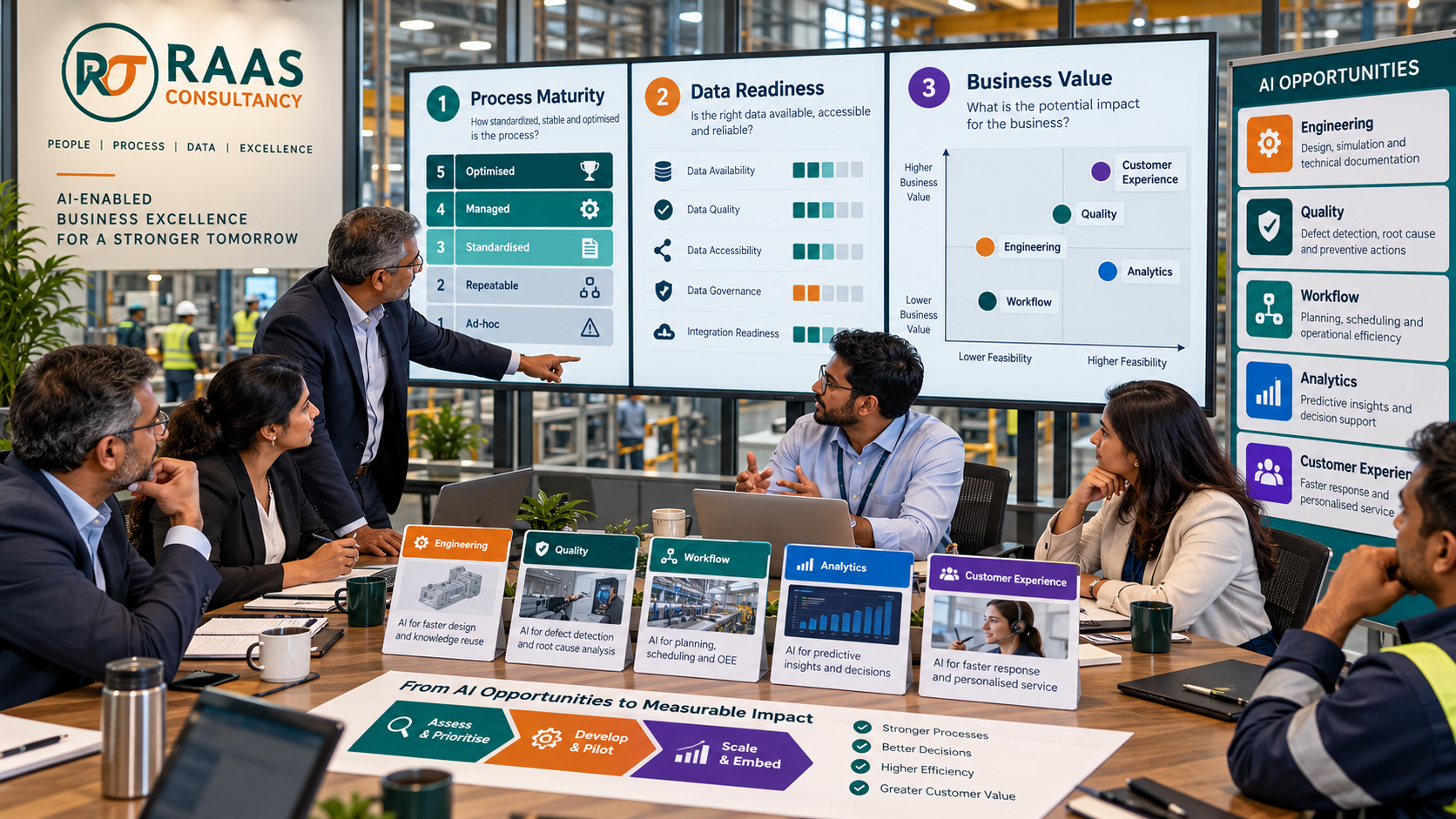
RAAS Consultancy helps organizations evaluate processes, data, improvement maturity and business opportunities before prioritizing AI, analytics and automation initiatives.
Book a SMART CI™ / AI Opportunity Assessment to identify where AI can create measurable value within your Continuous Improvement roadmap.

About Asim Inamdar
Asim Inamdar works with organizations to build practical problem-solving and operational excellence capability through Lean Six Sigma, structured improvement and leadership-led transformation.
Frequently Asked Questions
1. What is AI-powered Business Excellence?
AI-powered Business Excellence is the use of AI, analytics and automation to improve mature business processes, decisions and customer outcomes.
2. Why should process maturity come before AI?
Without stable processes, clear ownership and reliable data, AI can amplify inconsistency instead of eliminating it.
3. What should organizations assess before adopting AI?
They should understand the process, business problem, data quality, decision to be improved and expected economic value.
4. Can AI improve Lean Six Sigma?
Yes. AI can accelerate pattern detection, data analysis, knowledge retrieval and root-cause investigation, while Lean Six Sigma provides the structured method to validate and sustain improvement.
5. Where can AI help Business Excellence teams?
Potential applications include KPI analysis, project identification, automated reporting, knowledge management, anomaly detection and improvement prioritization.
6. What comes after SMART CI™ Level 5?
Level 6 is Customer Excellence, where internal improvement is connected directly to measurable customer value.