
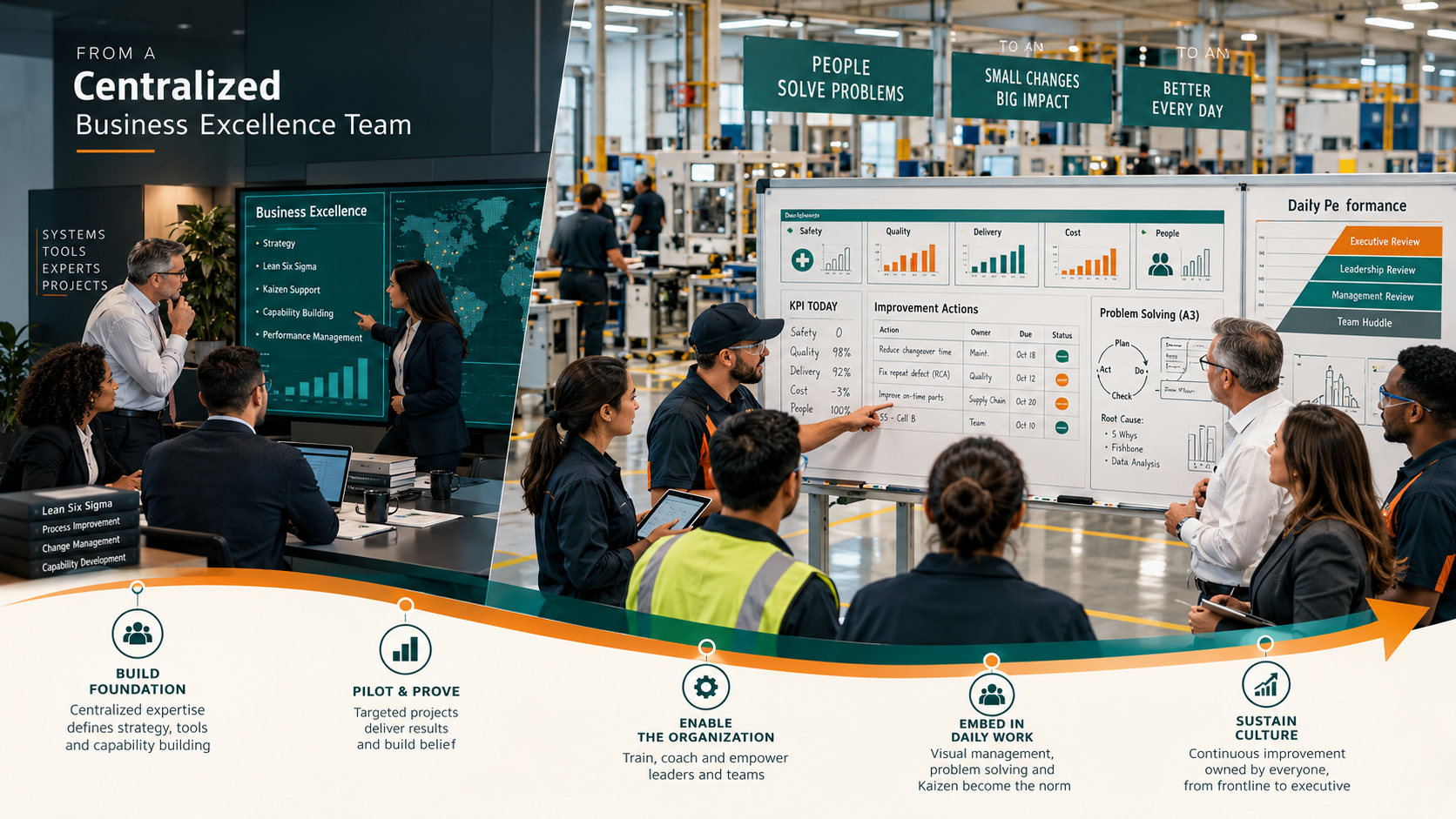
A Continuous Improvement culture exists when improvement no longer depends on a consultant, a Business Excellence department or a few Lean experts. Teams routinely identify abnormalities, use facts and structured problem solving, improve their own processes, escalate issues appropriately and learn from results. At SMART CI™ Level 4, improvement moves from being a specialist activity to becoming part of everyday management.
In this article, you will learn
- The difference between having a CI function and having a CI culture
- What changes at SMART CI™ Level 4
- Why Daily Management is essential
- How Kaizen, Lean Six Sigma, KPI reviews and tier meetings work together
- What “Intelligent Continuous Improvement” really means
- Why Level 4 creates the foundation for AI-powered Business Excellence
Do You Have a CI Team or a CI Culture?
Many organizations have a Business Excellence or Continuous Improvement department.
That team runs Lean projects, facilitates Kaizen workshops, conducts Root Cause Analysis, manages Value Stream Mapping exercises, delivers Corporate Trainings, supports audits and creates dashboards.
All of this is valuable. But there is one difficult question leadership should ask:
“What would happen if the Business Excellence team stopped driving improvement for six months?”
Would teams continue identifying waste?
Would supervisors keep solving recurring problems?
Would KPI reviews lead to root-cause discussions?
Would employees continue improving their work?
Would managers keep closing performance gaps systematically?
If improvement activity would slow dramatically, the organization has built a Continuous Improvement function. It may not yet have built a Continuous Improvement culture. That distinction defines SMART CI™ Level 4.
Level 4: Intelligent Continuous Improvement
The objective of Level 4 is to move from:
“Experts improve the organization.” → “The organization improves itself.”
This does not mean Business Excellence teams disappear. Their role changes.
Instead of owning every improvement, they increasingly build the system, coach leaders, develop problem-solving capability and help teams solve more complex issues. The people closest to the process begin taking greater ownership of improvement.
Lean Enterprise Institute describes a lean management system as one where everyone participates in ongoing problem solving based on verifiable facts rather than assumptions. The objective is not simply fixing problems once, but continuously learning from them.
That is the cultural shift Level 4 is trying to create.

1. Daily Management Makes Improvement Visible
Continuous Improvement cannot live only in monthly reviews. It has to connect with daily work.
A strong Daily Management System allows teams to compare expected performance with actual performance, identify abnormalities early and decide what action is required.
Target vs Actual
Make expected performance and current performance visible every day.
Gap Identification
Surface abnormalities early instead of allowing them to remain hidden.
Ownership
Define who owns the next action and when the result will be checked.
Learning
Review whether the action worked and standardize what was learned.
Typical questions become: What was the target? What actually happened? Where is the gap? Why does the gap exist? Who owns the next action? Has the action worked?
Daily management connects strategy with actual processes while engaging employees in daily problem solving.
The board is not the system. The behavior around the board is the system.
2. Kaizen Moves from Events to Daily Thinking
Many organizations know Kaizen through workshops. A team gathers for three or five days, studies a process and implements improvements.
These events can be powerful. But Kaizen maturity is reached when people do not wait for an event to improve their work.
Employees notice abnormalities, suggest practical improvements, experiment, check results and standardize what works.
Kaizen is fundamentally a continuous cycle involving people across the organization, not simply a calendar of workshops.
At Level 4, Kaizen becomes a habit.
3. Lean Six Sigma Becomes Part of Problem Solving
Not every issue needs a Green Belt project. But recurring, complex and high-impact problems require more than quick corrective action.
This is where Lean Six Sigma Projects and structured methods such as DMAIC, RCA, Pareto Analysis, 5 Why, Fishbone Analysis and statistical thinking become part of the organization's problem-solving language.
A problem that needs immediate containment.
A recurring problem that needs root-cause analysis.
A chronic performance gap that needs a structured improvement project.
A future-state opportunity that needs innovation.
The maturity comes from selecting the right problem-solving method rather than applying the same tool to every issue.
4. KPI Reviews Shift from Reporting to Problem Solving
A common management meeting sounds like this: Sales 96%. Quality 93%. Delivery 88%. Productivity 91%. Next slide.
That is reporting.
A mature Continuous Improvement review follows a different logic:
Performance → Gap → Root Cause → Action → Result
The conversation moves from “What is the number?” to “Why is the gap happening and what are we learning from it?”
This is where dashboards stop being presentation tools and start becoming management tools.
5. Tiered Management Escalates Problems to the Right Level
Not every problem should reach the CEO. And not every frontline problem can be solved by the frontline team.
Tiered management creates a structured escalation mechanism. Issues that can be resolved locally stay local. Issues requiring cross-functional support move upward. Issues requiring resources or strategic decisions reach the appropriate leadership tier.
Lean daily-management systems commonly use short, regular meetings and visual controls so problems can move through appropriate organizational levels instead of remaining hidden or being escalated chaotically.
That creates faster decisions and clearer accountability.
What Makes Continuous Improvement “Intelligent”?
In SMART CI™, Intelligent Continuous Improvement does not automatically mean Artificial Intelligence.
It means the organization becomes better at learning.
Facts & Reliable Data
Use evidence rather than assumptions to frame and prioritize problems.
Structured Problem Solving
Use disciplined methods to move from symptoms to validated causes.
Employee & Customer Knowledge
Connect frontline insight with customer feedback and operational context.
Analytics & Learning
Use process analytics, lessons learned and standards to improve decisions.
A dashboard without problem solving is information. A lesson-learned database nobody uses is storage. A KPI without action is a number.
The organization becomes intelligent when these elements influence decisions and continuously improve the way work is performed.
The Level 4 Maturity Shift
The SMART CI™ progression now looks different:
L1: “Something went wrong. Can we make execution repeatable?”
L2: “Can we find and prevent the root cause?”
L3: “Can we improve the complete process and reduce delays?”
L4: “Can we build a system that continuously identifies and eliminates improvement opportunities?”
That final question separates organizations that do improvement from organizations that continuously improve.

Then Comes the Next Disruption: AI
Once an organization has standardized processes, stronger quality systems, improved flow, a CI culture and reliable data, a new question becomes meaningful:
“Can AI make our improvement system faster, smarter and more predictive?”
Potential applications include knowledge management, document review, anomaly detection, AI-assisted RCA, quality analysis, workflow automation, customer insights, predictive analytics, management reporting and employee copilots.
But Level 5 should not become a technology race.
AI introduces both opportunity and risk, which is why frameworks such as NIST's AI Risk Management Framework emphasize deliberate governance and management of AI-related risks.
AI should augment a mature process, not hide an immature one.
That takes us to Level 5: AI-Powered Business Excellence.
RAAS Insight
The ultimate objective of Continuous Improvement is not more projects. It is an organization where improvement becomes the normal way of working.
If improvement stops when the expert leaves the room, capability has not yet been institutionalized. Level 4 is where that begins to change.

Is Continuous Improvement Embedded in Your Organization?
RAAS Consultancy helps organizations build the governance, Daily Management Systems, Lean Six Sigma capability, Kaizen practices and leadership mechanisms required to institutionalize Continuous Improvement.
Book a SMART CI™ Maturity Assessment to understand whether your organization has a CI function or a sustainable CI culture, and identify the capabilities required to move toward Level 5.

About Asim Inamdar
Asim Inamdar works with organizations to build practical problem-solving and operational excellence capability through Lean Six Sigma, structured improvement and leadership-led transformation.
Frequently Asked Questions
1. What is a Continuous Improvement culture?
A Continuous Improvement culture exists when employees and leaders routinely identify problems, use structured methods to solve them and improve their own processes without depending entirely on a central CI team.
2. What is SMART CI™ Level 4?
Level 4 is Intelligent Continuous Improvement, where Daily Management, Kaizen, Lean Six Sigma, KPI reviews, tiered management and organizational learning become integrated into normal management.
3. What is the difference between a CI function and a CI culture?
A CI function relies on specialists to drive improvement. A CI culture distributes problem-solving and improvement capability throughout the organization.
4. Why is Daily Management important?
Daily Management makes abnormalities visible, connects performance with goals and creates a regular cadence for problem solving and escalation.
5. Does Intelligent Continuous Improvement mean AI?
Not necessarily. At Level 4, “intelligent” primarily means using facts, data, employee knowledge, customer feedback and structured problem solving effectively.
6. When should an organization introduce AI into CI?
AI becomes more valuable when processes are understood, data is reliable and improvement systems are already functioning. This is the transition toward SMART CI™ Level 5.