
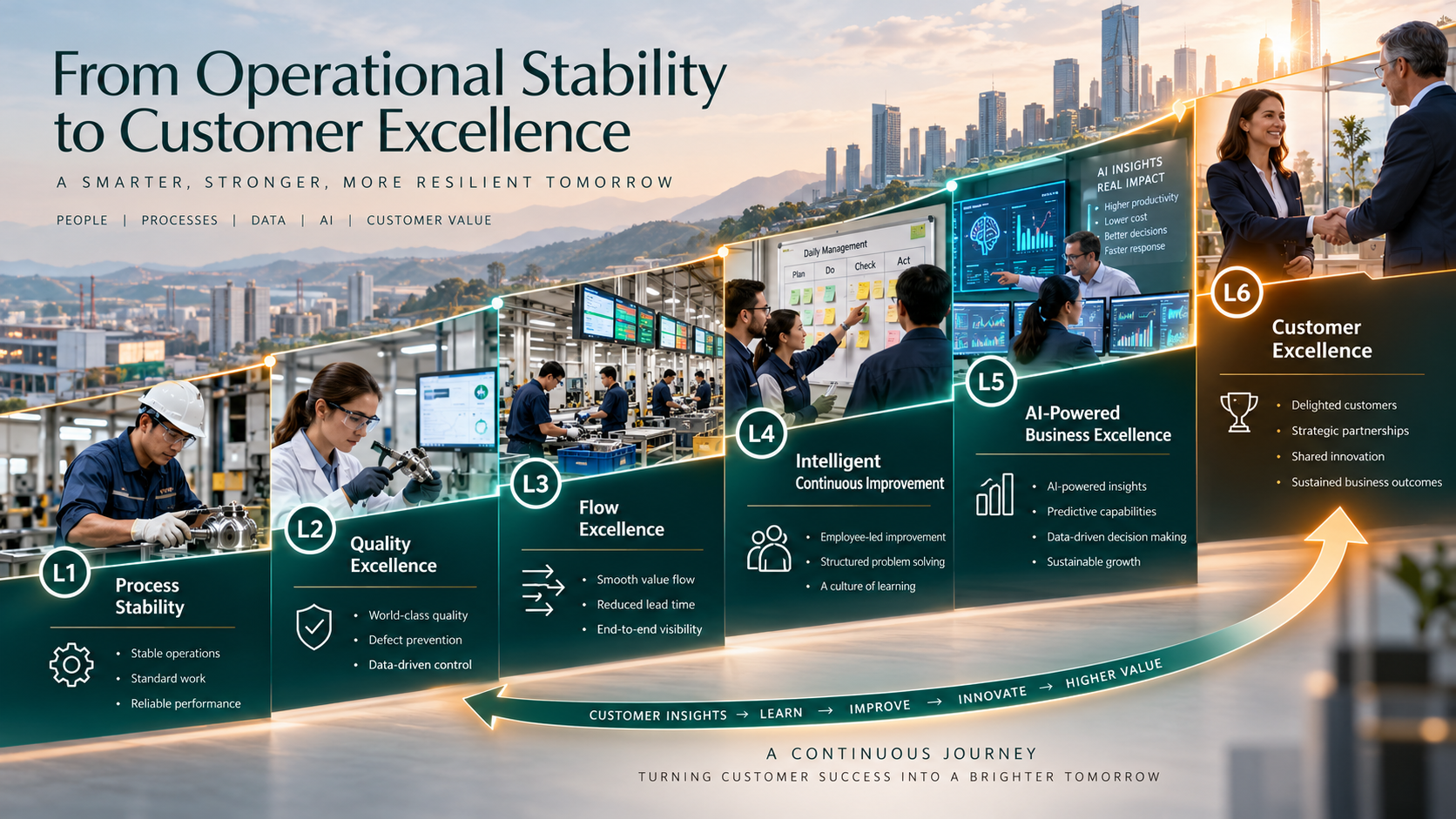
Customer Excellence is the final purpose of Continuous Improvement. Stable processes, better quality, faster flow, stronger problem solving, reliable data and intelligent automation matter because they should eventually create better outcomes for customers. SMART CI™ Level 6 connects internal operational maturity with external customer value.
In this article, you will learn
- Why Customer Excellence is the destination of the SMART CI™ journey
- How operational improvements translate into customer value
- What organizations should measure beyond project completion
- How the six SMART CI™ maturity levels connect
- Why maturity should become a management system, not a one-time assessment
- How RAAS Consultancy can help organizations build a structured roadmap
Why Are We Improving in the First Place?
Organizations invest significant time and resources in Lean Six Sigma, standardization, quality systems, Value Stream Mapping, Daily Management, data and analytics, automation and Artificial Intelligence.
But why?
The answer should not simply be “Because we want better processes.”
“Because better processes should create better business outcomes and greater customer value.”
This principle sits at the heart of Lean thinking. Lean Enterprise Institute defines value from the customer's perspective and describes Lean as creating more value with fewer resources and less waste. The starting point is understanding what the customer actually needs.
That makes Customer Excellence more than the final stage of SMART CI™. It is the reason the journey exists.
Level 6: Customer Excellence
Customer Excellence is not simply another name for Customer Service. Customer Service may handle requests, complaints, support and communication. Customer Excellence goes deeper.
“Is the entire organization consistently capable of understanding and delivering what customers value?”
The answer depends on everything that came before it.
Customer Excellence is therefore not an isolated function. It is the external result of internal maturity.
What Does Customer Excellence Actually Mean?
Customer Excellence means understanding customer needs, translating those needs into business requirements and continuously improving the organization's ability to deliver them.
ASQ's Voice of Customer framework emphasizes understanding customer needs and making them central to strategy and performance measures. It also highlights the importance of translating what customers say into the underlying needs and outcomes they actually value.
Depending on the business, useful measures may include:
Customer Satisfaction and customer feedback
SLA performance and on-time delivery
Customer health and escalation trends
Retention and repeat business
Quality performance
Business value delivered
But metrics alone are not enough.
What does the customer experience because our organization became better?
From Transactional Delivery to Strategic Value
Organization A
“We completed the customer's work.”
The requirement was received. The output was delivered. The transaction is finished.
Organization B
“We understand the customer's business, anticipate potential issues and continuously improve the value we deliver.”
This organization learns from customer feedback, improves its processes and strengthens the customer's outcome over time.
Lean does not define value internally. Value is judged from the customer's perspective. Operational efficiency without customer relevance can simply make an organization better at delivering something the customer values less.
The Complete SMART CI™ Maturity Journey
The six SMART CI™ levels can now be viewed as one connected capability journey.
Process Stability
Make the process consistent.
Establish standards, roles, discipline and repeatability.
Quality Excellence
Make the output reliable.
Reduce defects, strengthen prevention and improve Right First Time performance.
Flow Excellence
Make work move efficiently.
Reduce waiting, WIP, bottlenecks and unnecessary handoffs.
Intelligent Continuous Improvement
Make improvement part of everyday work.
Build Daily Management, Kaizen, structured problem solving and distributed improvement capability.
AI-Powered Business Excellence
Use data, AI and automation to amplify performance.
Apply technology where it improves decisions, productivity and measurable business outcomes.
Customer Excellence
Convert Operational Excellence into customer value.
Connect stronger capabilities to better customer outcomes.
The progression ultimately returns to the first principle of Lean: define value from the customer's perspective and keep improving how that value is created and delivered. Lean Enterprise Institute describes this as an ongoing practice rather than a permanent end state.

The Most Important Part: Level 6 Is Not the End
It may be called Level 6, but it is not a finish line. Customer needs change. Technology changes. Competition changes. Processes change. Expectations change.
Measure → Learn → Improve → Innovate → Create Customer Value
Lean itself is built around repeatedly improving toward better value with less waste rather than reaching a permanent final state.
This is why SMART CI™ should eventually operate as a management system, not as a one-time consulting assessment.
Where Should an Organization Start?
Not by implementing everything simultaneously. Start with six questions:
Where are we today?
What is our current maturity across the eight SMART CI™ capability dimensions?
Where do we want to go?
What level of capability does our strategy require?
What are our largest gaps?
Which capabilities are limiting performance?
Which gaps have the greatest business and customer impact?
Not every weakness deserves equal priority.
What should we implement first?
Sequence improvement logically.
How will we know it worked?
Define operational and customer outcomes before implementation begins.
That creates focus.
Turning Assessment into Transformation
RAAS Consultancy's SMART CI™ approach can help organizations move through a structured journey:
ASSESS maturity across the eight capability dimensions. PRIORITIZE the gaps with the greatest operational and customer impact. DESIGN a customized transformation roadmap. IMPLEMENT the appropriate mix of Lean Six Sigma, Value Stream Mapping, Quality Management, Standardization, Daily Management, Data & Analytics, AI & Automation and Customer Experience practices. BUILD CAPABILITY through coaching, Corporate Trainings and practical implementation. MEASURE maturity progression and business outcomes. SUSTAIN Continuous Improvement in everyday management.

The Final Question for the CEO
Do not ask only: “How many Lean Six Sigma projects did we complete this year?”
“How much more capable is our organization today than it was one year ago?”
And then ask the question that matters even more:
“How much more value are our customers experiencing because of that improvement?”
That is the essence of the SMART CI™ journey.
RAAS Insight
Business Excellence is not proven by the number of projects completed. It is proven when stronger organizational capability creates greater customer value.
Ready to Understand Where Your Organization Stands?
RAAS Consultancy can conduct a SMART CI™ Maturity Assessment across the eight capability dimensions, identify your current maturity, highlight critical gaps and develop a customized implementation roadmap aligned with your business priorities.
From Process Stability to Customer Excellence: Assess → Prioritize → Design → Implement → Build Capability → Measure → Sustain.

About Asim Inamdar
Asim Inamdar works with organizations to build practical problem-solving and operational excellence capability through Lean Six Sigma, structured improvement and leadership-led transformation.
Frequently Asked Questions
1. What is Customer Excellence?
Customer Excellence is an organization's ability to consistently understand, deliver and improve the value experienced by its customers.
2. How is Customer Excellence different from Customer Service?
Customer Service is one customer-facing function. Customer Excellence depends on the entire organization, including process quality, delivery, flow, data, decision-making and Continuous Improvement.
3. Why is Customer Excellence the final SMART CI™ level?
Because internal improvement ultimately needs to create external value. Stable processes, quality, flow, data and AI matter when they improve customer outcomes.
4. What metrics can measure Customer Excellence?
Measures may include CSAT, SLA performance, on-time delivery, customer feedback, escalation trends, retention, repeat business and measurable business value delivered.
5. Does SMART CI™ end at Level 6?
No. Maturity is continuous. Organizations should repeatedly measure, learn, improve and innovate as customer expectations and business conditions change.
6. How should an organization begin the SMART CI™ journey?
Start with a maturity assessment, identify capability gaps, prioritize those with the greatest business and customer impact, and create a sequenced implementation roadmap.