
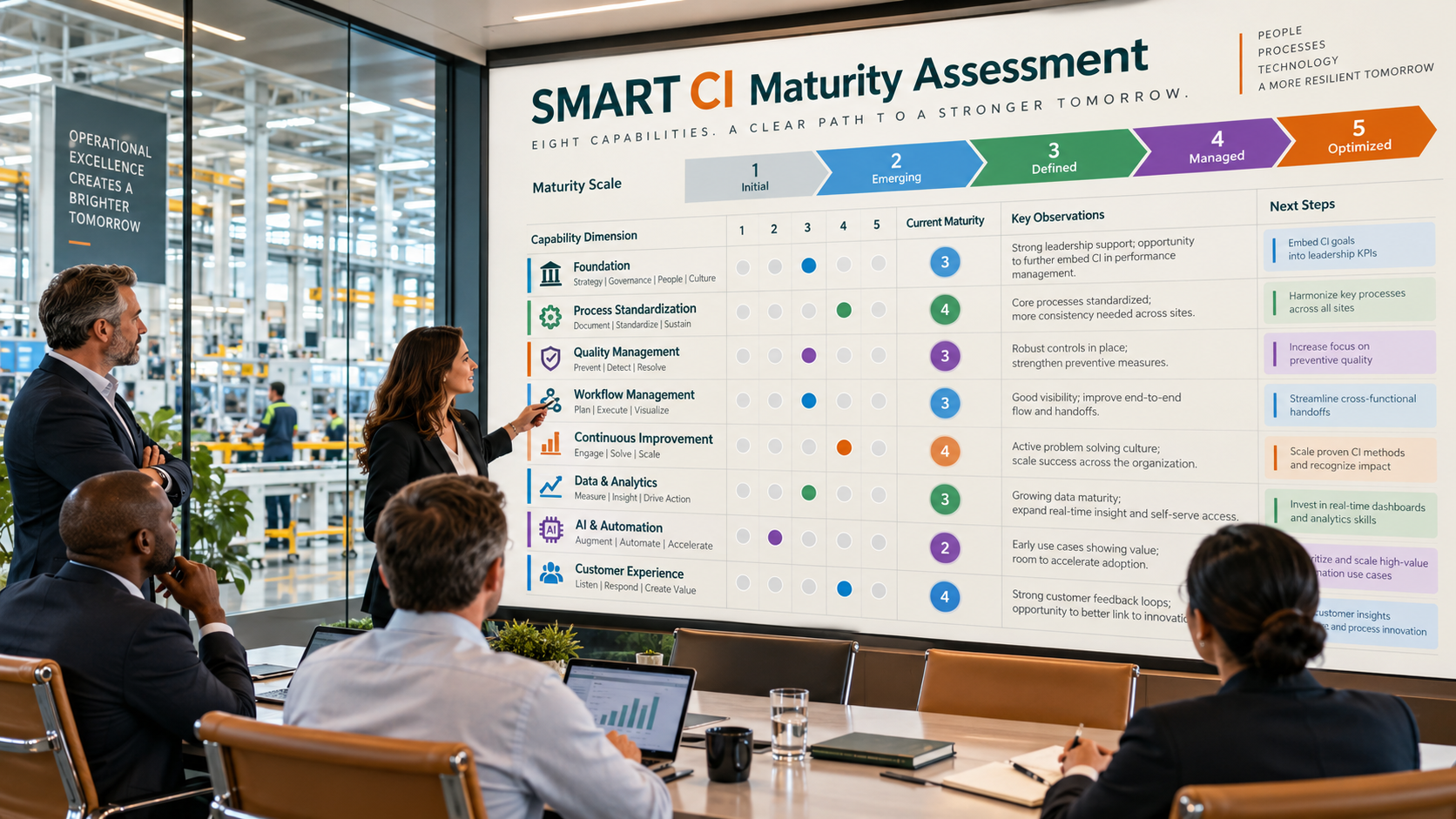
A Continuous Improvement maturity assessment helps an organization understand whether improvement is truly embedded into the way it works. A 1–5 maturity score can reveal capability gaps across leadership, process standardization, quality management, workflow, continuous improvement, data, AI, automation, and customer experience. The goal is not to create another report. The goal is to convert current-state maturity into a clear improvement roadmap.
In this article, you will learn
- Why completed Lean Six Sigma projects do not always prove maturity
- How RAAS SMART CI™ assesses organizational capability
- Why maturity must be scored element by element
- What the 1–5 maturity scale reveals
- How assessment results should become a transformation roadmap
Activity Is Not the Same as Maturity
Ask a Quality Head or Business Excellence leader: “How mature is your organization in Continuous Improvement?”
You may hear answers like: “We have Lean Six Sigma.” “We have trained Green Belts.” “We have ISO certification.” “We have dashboards.” “We have automation.” “We run Kaizen projects.”
All of these are useful. But none of them, individually, proves that Continuous Improvement is mature.
An organization can have 50 trained Green Belts, 100 Kaizen projects, multiple dashboards, ISO certifications and automation initiatives, yet still face recurring customer complaints, inconsistent SOP adherence, poor handoffs, unreliable data and slow problem resolution.
This is why a maturity assessment matters.
Capability maturity models are widely used to understand current organizational capability, benchmark practices and set improvement priorities. Operational excellence maturity models also commonly assess multiple dimensions such as process discipline, governance, people capability, performance management, technology and continuous improvement systems.
Why Project Counts Can Mislead Leaders
Completed projects can create confidence. But they can also hide deeper gaps.
A company may show a long list of completed Lean Six Sigma Projects but still struggle with basic execution consistency. Another company may have strong dashboards but poor data quality. A third may have automation pilots but weak process standardization.
The problem is not that projects are useless. Projects are important. The issue is that projects measure activity. Maturity measures capability.
A project answers: “What did we complete?”
A maturity assessment asks: “What are we capable of doing consistently?”
That is a very different leadership conversation.
The RAAS SMART CI Assessment
RAAS SMART CI uses eight capability dimensions to assess organizational maturity. Each dimension looks at whether Continuous Improvement is supported by the right leadership, systems, behaviors, processes, data and customer focus.
Foundation
Leadership engagement, employee involvement, governance, culture, communication, training and technology infrastructure.
Process Standardization
SOPs, standard work, role clarity, process documentation, digital workplace practices and knowledge management.
Quality Management
Voice of Customer, CTQs, quality gates, audits, RCA and CAPA that prevent repeat problems.
Workflow Management
Value Stream Mapping, capacity management, queue and WIP management, visual management and end-to-end flow.
Continuous Improvement
Daily management, Kaizen, Lean Six Sigma, DMAIC, KPI reviews and tier meetings.
Data & Analytics
KPI architecture, dashboards, data quality, data governance and analytical insights that support better decisions.
AI & Automation
AI strategy, AI copilots, RPA, AI-enabled RCA, intelligent quality and innovation use cases.
Customer Experience
CSAT, SLA and on-time delivery, customer health, escalation management, feedback systems and relationship management.
A mature CI system does not stop at internal efficiency. The final test is whether customers experience better quality, faster response, fewer escalations, better reliability and higher value.

Why Score Every Element from 1 to 5?
Because maturity is rarely uniform.
An organization might have Leadership Engagement = 4, Data Quality = 2, AI Capability = 1 and Customer Experience = 3.
If you only look at the average score, the real gaps may remain hidden. That is why SMART CI looks at individual capability elements, not just the overall maturity number.
Many maturity models use staged scoring to show progression from reactive or initial practices toward managed, optimized and continuously improving systems. SMART CI applies that thinking to the practical realities of business excellence, operations and customer value.
The SMART CI 1–5 Maturity Scale
The 1–5 scale helps leadership teams move from opinion to evidence. For every element, the question is not “What do we believe our maturity is?” The better question is “What evidence demonstrates our current maturity?”
| Score | Maturity | What it means |
|---|---|---|
| 1 | Initial | Practices are inconsistent, reactive or person-dependent. |
| 2 | Basic | Some practices exist, but they are not consistently applied. |
| 3 | Defined | Processes and expectations are documented and understood. |
| 4 | Managed | Performance is reviewed, improved and controlled through leadership systems. |
| 5 | Optimized | The capability is continuously improved, scaled and linked to business outcomes. |
The Result Should Not Be a Report That Sits on a Shelf
A maturity assessment has value only when it leads to action. The output should move through this path:
This converts the assessment into a roadmap.
If process standardization is weak, the priority may be SOPs, standard work and role clarity. If workflow maturity is weak, the priority may be VSM, WIP control and visual management. If data maturity is weak, the priority may be KPI architecture and data governance. If AI maturity is weak, the priority may be use-case selection after process and data readiness.
This is how maturity scoring becomes transformation planning.

RAAS Point of View
At RAAS Consultancy, SMART CI is not designed to judge an organization.
It is designed to help leaders see clearly.
The purpose is to identify where improvement capability is strong, where it is weak and what must be built next.
A maturity-based approach helps organizations avoid random improvement activity. It helps leaders prioritize the next capability needed for sustainable business excellence.
Practical Takeaway
Before launching another project, ask:
Which CI capability is weakest today?
Are our improvement projects solving symptoms or maturity gaps?
Is our data strong enough to support better decisions?
Are we automating stable processes or unstable ones?
Are improvement efforts improving customer value?
The answers can reveal where your organization truly stands.
Final Thought
A 1–5 maturity score can reveal much more than a list of completed projects.
It can show whether Continuous Improvement is stable, scalable and connected to business outcomes.
The real value of SMART CI is not the score. The real value is the roadmap that follows.

Ready to Assess Your CI Maturity?
RAAS Consultancy can conduct a structured SMART CI Maturity Assessment and convert the findings into a prioritized implementation roadmap.
Book a diagnostic call with RAAS Consultancy to understand where your organization stands today and what capability should be built next.

About Asim Inamdar
Asim Inamdar works with organizations to build practical problem-solving and operational excellence capability through Lean Six Sigma, structured improvement and leadership-led transformation.
Frequently Asked Questions
1. What is a Continuous Improvement maturity assessment?
A Continuous Improvement maturity assessment evaluates how well an organization has built the systems, behaviors, processes, data and leadership practices required to sustain improvement.
2. Why is project activity not the same as maturity?
Project activity shows what has been completed. Maturity shows whether the organization can improve consistently, sustain gains and scale capability across functions.
3. What are the eight SMART CI assessment dimensions?
The eight dimensions are Foundation, Process Standardization, Quality Management, Workflow Management, Continuous Improvement, Data & Analytics, AI & Automation and Customer Experience.
4. Why does SMART CI use a 1–5 maturity scale?
The 1–5 scale helps organizations understand whether each capability is Initial, Basic, Defined, Managed or Optimized.
5. Why should each element be scored separately?
Each element should be scored separately because maturity is rarely uniform. A company may be strong in leadership but weak in data quality, AI readiness or workflow management.
6. What should happen after a maturity assessment?
The assessment should lead to gap analysis, priorities, improvement projects, capability building and reassessment.