
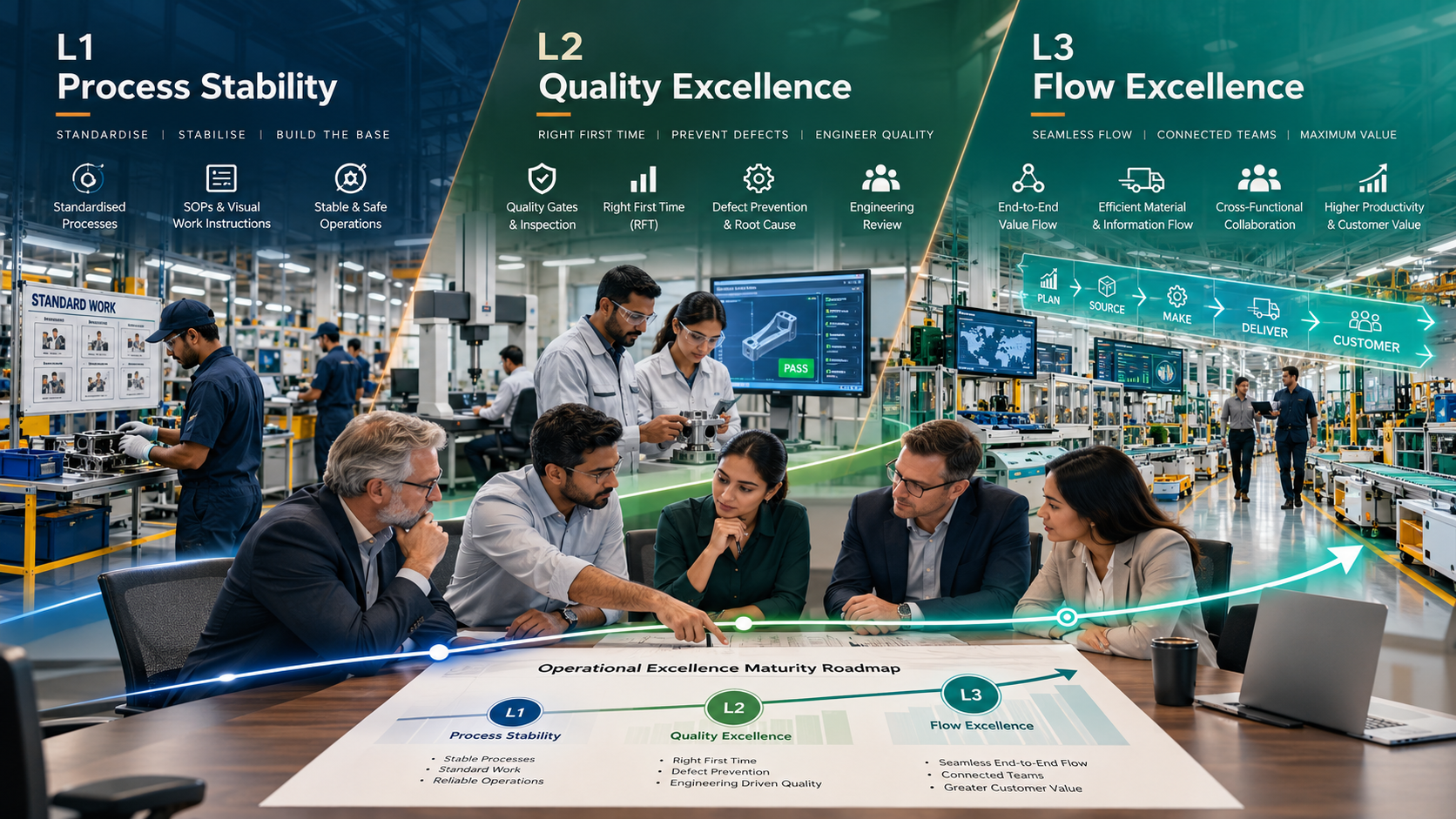
The first three levels of Continuous Improvement maturity should build on each other. Process Stability creates consistent and repeatable execution. Quality Excellence ensures that stable processes produce the right output consistently. Flow Excellence then removes waiting, WIP, bottlenecks and poor handoffs across the value stream.
Trying to optimize flow, automate work or introduce AI before these foundations exist can simply accelerate an unstable process.
In this article, you will learn
- Why Process Stability should come before advanced transformation
- How Quality Excellence moves organizations from detection to prevention
- Why Flow Excellence requires end-to-end thinking
- How L1, L2 and L3 build on each other
- Why organizations should resist jumping directly to AI and automation
The Temptation to Start with Something Advanced
Every transformation journey seems to begin with an exciting question.
Can we automate this?
Can AI predict the problem?
Can we build a smarter dashboard?
Can we introduce predictive analytics?
Can we digitally transform the process?
These may all be valuable opportunities. But there is a more fundamental question leadership should ask first: Is the process itself ready?
Technology can accelerate a strong process. It can also accelerate inconsistency.
If five people perform the same activity five different ways, digitizing that workflow does not automatically create excellence. It may simply digitize five different versions of the same process.
This is why the RAAS SMART CI™ maturity journey begins with three fundamental capabilities: Stability → Quality → Flow.
This sequence is consistent with core Lean thinking. Standardized work creates a documented baseline, reduces variability and provides a foundation for improvement. Lean Enterprise Institute also describes standardized work as a basis for ongoing Kaizen rather than an end state.
Level 1: Process Stability
The leadership question: “Can we consistently perform the process the way it is supposed to be performed?”
Process Stability is the foundation.
At this level, the organization is not trying to create a world-class process overnight. It is trying to make the current process visible, repeatable and manageable.
Standard Work & SOPs
Create a common, documented baseline for how work should be performed.
Roles & Governance
Clarify ownership, responsibilities, process documentation and basic governance.
Capability & Daily Management
Train people, establish daily management and use visual controls.
Performance Measures
Use clear measures to make execution visible and prove improvement.
Consider an engineering team with five designers performing similar work. One uses a personal checklist. One relies on experience. One uses an old project as reference. One follows a documented standard. One has created their own method.
The organization does not really have one process. It has five interpretations of the process. That creates variation before quality analysis even begins.
Standardization should not mean freezing a process forever. The purpose is to establish the current best-known method so there is a baseline from which teams can improve. Lean Enterprise Institute describes standardized work as a foundation for Kaizen and ongoing improvement. Without a standard, even the word “improvement” becomes difficult to prove.
Level 2: Quality Excellence
Once work becomes reasonably stable, leadership can ask the next question: “Are we consistently performing the process correctly?”
This is where the organization moves from basic execution discipline toward Quality Excellence.
The critical maturity shift is: Detection → Correction → Prevention.
At lower maturity: “The customer found the problem.” At a stronger level: “Our inspection or quality gate detected it.” At a more mature level: “Our process prevented it from happening.”
That is a very different quality system.
The organization begins strengthening capabilities such as Voice of Customer, CTQs, quality gates, audits, Root Cause Analysis, CAPA and defect analysis.
The objective is not simply to become better at finding failures. It is to become better at preventing recurrence. ASQ describes CAPA as a disciplined approach for correcting causes and preventing recurrence.
What changes at Level 2?
Quality stops belonging only to the Quality department. Operators, engineers, supervisors, service teams and process owners begin taking responsibility for the quality of work passed downstream.
Old model: Produce → Inspect → Correct
Stronger model: Understand requirement → Control process → Prevent defect → Verify output
This improves far more than defect rates. It reduces rework, customer complaints, delays, COPQ and operational firefighting.
Level 3: Flow Excellence
Once the process is stable and quality is becoming predictable, a new constraint becomes visible: Time.
The leadership question becomes: “How efficiently does value move through the organization?”
This is where Value Stream Mapping and end-to-end thinking become powerful.
Most organizations are structured vertically into departments. Customers experience the business horizontally.
A customer requirement may move through: Customer Request → Sales → Planning → Engineering → Procurement → Execution → Quality → Delivery → Customer.
Each function may appear efficient individually. Yet the entire value stream can still be painfully slow because much of the delay exists between activities.
Waiting
Work waits for approvals, decisions or information.
Clarification
Information pauses because requirements or ownership are unclear.
WIP & Queues
Work accumulates between functions even when local departments look busy.
Handoffs
Cross-functional transitions create delay, rework and loss of context.
A task may require only two hours of actual processing but spend five days travelling through the organization.
Value Stream Mapping explicitly distinguishes processing measures from total lead time and exposes where work or material stops flowing.
At L3, leadership begins asking: Where is work waiting? Where is WIP accumulating? Where are handoffs failing? Which approvals are slowing delivery? Where are resources overloaded? Which activities genuinely create customer value? What is our total lead time? How much of that time is actually value-added?
This moves improvement from department optimization to system optimization.
The Critical L1 → L3 Progression
The first three SMART CI™ levels answer three different questions:
Process Stability
Can we consistently perform the work?
Quality Excellence
Can we consistently perform the work correctly?
Flow Excellence
Can we move that work efficiently through the complete system?
The sequence matters. Trying to create faster flow with unstable processes creates chaos. Creating faster flow while producing defects moves bad output faster. Automating either situation simply increases the speed of the problem.
That is why stability, quality at the source and flow are closely connected in Lean operating systems. Lean Enterprise Institute similarly emphasizes the importance of stable, connected flow systems.

This Is Not Just a Manufacturing Model
The same logic applies to engineering services, software, IT/ITeS, shared services, healthcare, financial services, logistics and professional services.
The specific standard will look different.
A manufacturing standard may define work sequence and takt. An engineering standard may use design gates and checklists. A service standard may define handoffs, response criteria and decision rules.
Make the work visible → establish the standard → improve quality → improve flow.
Standardized work principles can also be adapted to business and transactional processes rather than being limited to factory environments.

But L3 Is Not the Destination
An organization can achieve stable processes, strong quality and smooth flow and still face a ceiling.
Why? Because improvement may still depend on a central Business Excellence team, consultants or a few highly experienced people.
That leads to the next maturity question: “Can the organization continuously improve itself?”
This is the transition to L4: Intelligent Continuous Improvement. And it changes Continuous Improvement from a project methodology into an organizational capability.
RAAS Insight
Stability creates the platform. Quality builds reliability. Flow creates speed. Continuous Improvement creates sustainability.
Before asking how quickly your organization can adopt AI, automation or advanced analytics, ask whether the first three foundations are strong enough to support them.
Practical Takeaway
Before advancing to the next transformation layer, leadership teams should test the strength of the foundation:
Are core processes standardized and repeatable?
Are quality problems being prevented rather than repeatedly detected?
Does work flow efficiently across the complete value stream?
Are handoffs, WIP and approval delays visible?
Is the organization ready to build distributed Continuous Improvement capability?
Final Thought
The first three SMART CI™ levels are not basic steps to rush through. They are the operating foundation on which advanced transformation depends.
Stabilize the work. Build quality into the process. Create flow across the value stream. Then scale Continuous Improvement, data, AI and automation on top of a stronger system.
Is Your Organization Ready to Move Beyond L1–L3?
RAAS Consultancy helps organizations assess Process Stability, Quality Excellence and Flow Excellence and translate the findings into a structured SMART CI™ maturity roadmap.
Book a SMART CI™ Maturity Assessment to understand where your foundation is strong, where capability gaps remain, and what your organization should build next.

About Asim Inamdar
Asim Inamdar works with organizations to build practical problem-solving and operational excellence capability through Lean Six Sigma, structured improvement and leadership-led transformation.
Frequently Asked Questions
1. What are the first three levels of SMART CI™?
They are L1 Process Stability, L2 Quality Excellence and L3 Flow Excellence.
2. Why does Process Stability come first?
Without repeatable processes and clear standards, performance varies and improvement cannot be measured reliably.
3. What is Quality Excellence?
Quality Excellence means moving from detecting defects after they occur toward systematically preventing problems through VOC, CTQs, quality gates, RCA and CAPA.
4. What is Flow Excellence?
Flow Excellence focuses on moving work efficiently across the complete value stream by reducing waiting, WIP, handoff delays, bottlenecks and unnecessary activities.
5. Can organizations skip directly to AI and automation?
Technology may still be deployed, but applying it to unstable, poorly standardized processes or unreliable data can magnify existing problems rather than remove them.
6. What comes after Flow Excellence?
The next SMART CI™ level is L4: Intelligent Continuous Improvement, where improvement begins becoming a distributed organizational capability rather than depending on a few experts.