
Continuous Improvement initiatives lose momentum when organizations treat improvement as a collection of projects instead of a business capability. Tools like 5S, Kaizen, Lean Six Sigma, VSM and RCA can deliver results, but without process stability, leadership sponsorship, standard KPIs, employee involvement, data discipline and customer feedback loops, improvement often depends on a few individuals and fades over time.
In this article, you will learn
- Why Lean Six Sigma projects alone do not always create lasting improvement
- What separates project activity from organizational maturity
- How RAAS SMART CI™ defines the journey from Process Stability to Customer Excellence
- Why AI should come after process stability, not before it
- How CXOs can start assessing their Continuous Improvement maturity
The Real Problem Is Not Always the Project
Many organizations have already started their Continuous Improvement journey.
They have conducted 5S drives. They have run Kaizen events. They have completed Lean Six Sigma Projects. They have trained Green Belts. They have created dashboards. They have done RCA, VSM, automation and quality improvement workshops.
For a while, the organization feels active.
“Why is Continuous Improvement not becoming part of the way we work?”
This is an important question for CXOs and Business Excellence leaders. Continuous Improvement should not remain a campaign, workshop series or project tracker. It should become an organizational capability.
The Project Paradox
An organization may complete 20 improvement projects and still struggle with daily operational issues.
Recurring problems continue and processes remain inconsistent.
Teams still firefight and customer escalations keep coming back.
Data is unreliable, collaboration is weak and decisions are slow.
Employee involvement is low and improvement depends on a few committed individuals.
This is the project paradox. The organization is doing improvement work, but the system around that work has not matured.
The issue is not always the absence of tools. In many cases, the tools are already present. The issue is that the organizational maturity required to sustain those tools is missing.
Activity Is Not the Same as Maturity
There is a major difference between conducting improvement activities and building improvement maturity.
Organization A runs improvement projects whenever a major problem occurs. It reacts quickly, conducts meetings, forms teams, closes actions and moves to the next issue.
Organization B has leadership sponsorship, standard processes, defined KPIs, structured problem solving, employee involvement, visual management, data-driven decisions, automation and customer feedback loops.
Both organizations may know Lean Six Sigma. But only one has converted improvement into a management system. That difference is maturity.
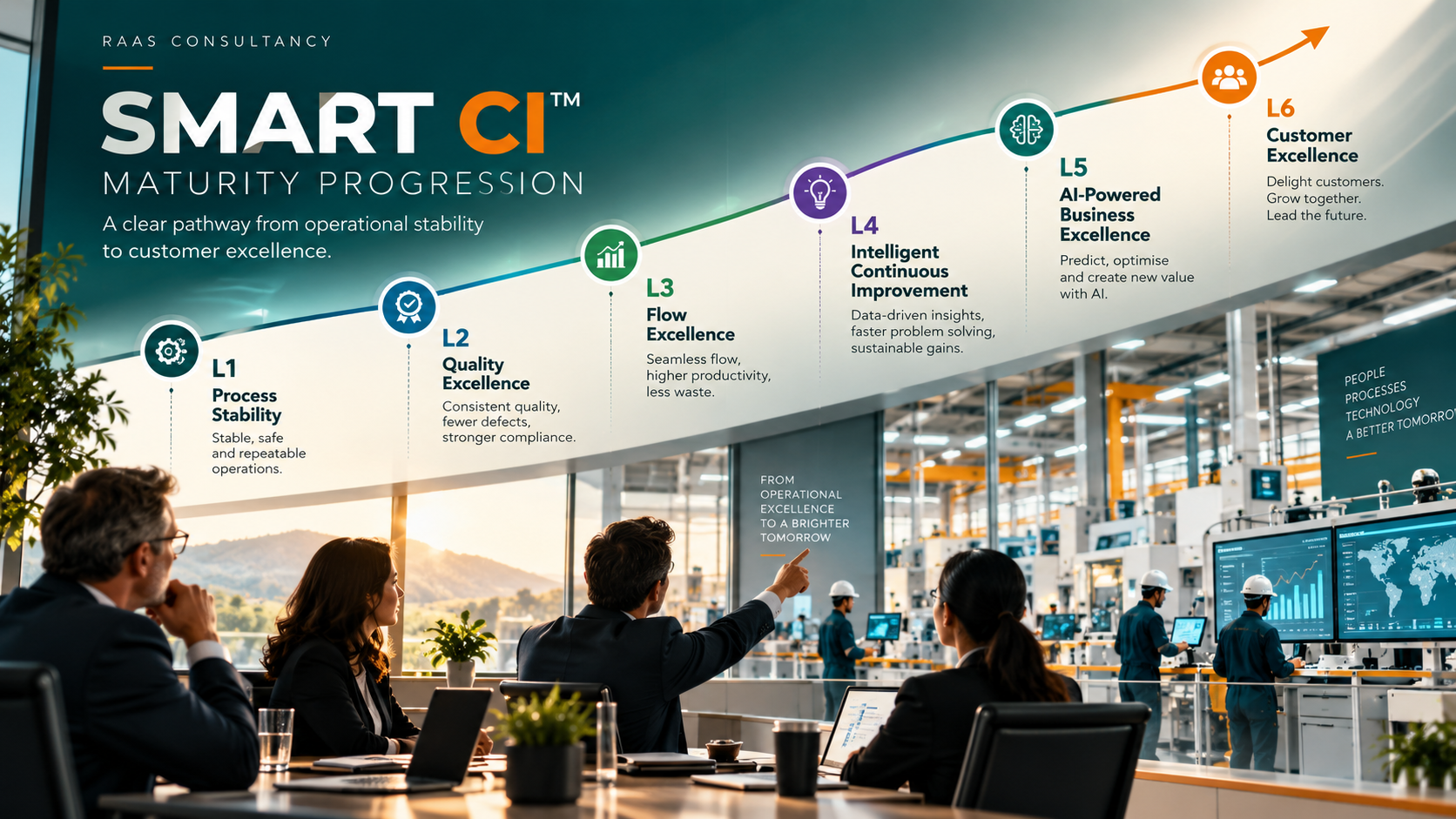
Introducing RAAS SMART CI™ Maturity Progression
RAAS Consultancy developed the SMART CI™ Maturity Progression to help organizations understand where they are in their Continuous Improvement journey.
SMART CI™ stands for Sustainable, Measurable, AI-enabled Rapid Transformation for Continuous Improvement.
Process Stability
Create repeatable and predictable execution.
Quality Excellence
Deliver right first time.
Flow Excellence
Improve flow and reduce lead time.
Intelligent Continuous Improvement
Build a culture of continuous improvement.
AI-Powered Business Excellence
Scale excellence with AI and intelligent systems.
Customer Excellence
Delight customers and deliver value.
The goal is not to chase a higher score for the sake of scoring. The goal is to build organizational capability step by step.

The Critical Shift: From Projects to Capability
Traditional improvement thinking asks: “Which project should we do next?”
A maturity-based approach asks: “What capability must we build next?”
That is a very different leadership conversation.
A project mindset focuses on activity. A maturity mindset focuses on capability. A project may reduce defects in one area. A maturity system helps prevent similar defects across the organization. A project may improve one process. A maturity system helps the organization improve continuously.
This is where leadership attention matters.

What CXOs Should Ask
For CXOs, the real question is not only whether improvement projects are happening. The better questions are:
Are our processes stable and repeatable?
Are quality problems systematically prevented?
Does work flow smoothly across functions?
Are employees solving problems continuously?
Are data, AI and automation helping people make better decisions?
Are these capabilities improving customer experience?
If the answer to several of these questions is “not consistently,” then the organization may not have an improvement project problem. It may have a maturity gap.
Why the Journey Must Start with Level 1
Many organizations today want to move directly to AI. They ask how they can use AI for improvement, automate decision-making or create intelligent dashboards.
These are valid questions. But there is one risk.
AI applied to an unstable process can simply automate instability.
If the process is inconsistent, the data is unreliable and the standards are unclear, AI will not automatically create excellence. It may only make poor decisions faster.
That is why Process Stability comes first. A stable process creates the foundation for quality. Quality creates the foundation for flow. Flow creates the foundation for continuous improvement. Continuous improvement creates the foundation for intelligent systems. Intelligent systems create the foundation for customer excellence.
RAAS Point of View
At RAAS Consultancy, Continuous Improvement is not treated as a one-time project function. It is treated as a business capability.
The purpose of Lean Six Sigma, Kaizen, Value Stream Mapping, Root Cause Analysis, TPM, dashboards and automation is not only to complete initiatives. The purpose is to build a stronger organization.
An organization that solves problems at the right level, uses data properly, improves flow, prevents quality problems, uses AI intelligently and ultimately delivers better customer value.
That is the purpose of SMART CI™.
Practical Takeaway
Before launching the next improvement project, leadership teams should pause and ask:
What maturity level are we operating at today?
Are we trying to improve unstable processes?
Are we using tools without building capability?
Are improvements sustained after the project ends?
Are CI efforts improving customer value?
These questions help move the organization from activity to maturity.
Final Thought
Continuous Improvement loses momentum when it is treated as a set of tools, events or projects.
It gains momentum when it becomes part of how the organization thinks, manages, solves problems and serves customers.
The next breakthrough may not come from doing more projects. It may come from understanding your current maturity and building the next capability your organization truly needs.

Want to Understand Your Current SMART CI™ Maturity?
RAAS Consultancy can conduct a structured SMART CI Maturity Assessment and help create a customized roadmap from Process Stability to Customer Excellence.
Book a diagnostic call with RAAS Consultancy to assess where your organization stands today and what capability must be built next.

About Asim Inamdar
Asim Inamdar works with organizations to build practical problem-solving and operational excellence capability through Lean Six Sigma, structured improvement and leadership-led transformation.
Frequently Asked Questions
1. Why do Continuous Improvement initiatives lose momentum?
Continuous Improvement initiatives lose momentum when they depend on isolated projects, individual champions or short-term activities instead of a mature organizational system.
2. What is Continuous Improvement maturity?
Continuous Improvement maturity is the organization’s ability to sustain process stability, quality excellence, flow improvement, structured problem solving, data-driven decisions and customer value creation.
3. What is RAAS SMART CI™?
RAAS SMART CI™ is a Continuous Improvement maturity progression framework that helps organizations move from Process Stability to Customer Excellence through six maturity levels.
4. Why should process stability come before AI?
AI applied to unstable processes can automate instability. Organizations should first stabilize and standardize processes before scaling AI-enabled improvement.
5. How can CXOs assess CI maturity?
CXOs can assess CI maturity by reviewing process stability, quality prevention, flow performance, employee involvement, data reliability, AI readiness and customer value impact.
6. What is the benefit of a maturity-based approach?
A maturity-based approach helps organizations build long-term improvement capability instead of running disconnected improvement projects.